- About
- Programs
- Faculty of Graduate Studies and Research
- PhD in Business and Management Studies
- PhD in Information and Communication Technology
- Master of Science in Information Technology (MSc.IT)
- Master of Science in Cyber Security and Forensics
- Master of Science in Digital Finance and Technology
- Master of Science in Public Health (General)
- Master of Science in Public Health – Health Informatics
- Master of Science in Public Health – Epidemiology and Biostatistics
- Master of Business Administration (MBA)
- Faculty of ICT
- Master of Science in Information Technology (MSc.IT)
- Master of Science in Cyber Security and Forensics
- Bachelor of Science in Animation and Visual Effects (B.Sc. VFX)
- Bachelor of Science in Applied Information Technology (B.Sc. AIT)
- Bachelor of Science in Artificial Intelligence and Machine Learning (B.Sc. AI & ML)
- Bachelor of Science in Networking and Cyber Security (B.Sc. NCS)
- Bachelor of Science in Computer Science (B.Sc. CS)
- Faculty of Health Sciences
- Faculty of Business & Commerce
- Master of Science in Digital Finance and Technology
- Master of Business Administration (MBA)
- Bachelor of Business Administration in International Marketing (BBA-IM)
- Bachelor of Business Administration in International Business (BBA-IB)
- Bachelor of Hotel Management (BHM)
- Bachelor of Human Resource Management (BHRM)
- Bachelor of Science in Applied Economics (BSc-AE)
- B.Sc. Accounting and Finance
- Faculty of Engineering
- Diploma Programmes
- Pre-University / International Foundation
- Short Courses (Professional / Skill-based)
- Certified Cyber Security Specialist (CCSS)
- Certified Ethical Hacker (CEH) Certification
- Computer Hacking Forensic Investigator (CHFI) Certification
- ISBAT Certified Integrated IT Infrastructure Specialist Programme
- Data Science
- Python
- Cloud Computing
- Linux for Beginners
- Cyber Security for Beginners
- Certified Network Associate (CNA)
- PMP
- Faculty of Graduate Studies and Research
- ISBAT Online
- Research & Innovation
- Alumni
- Career
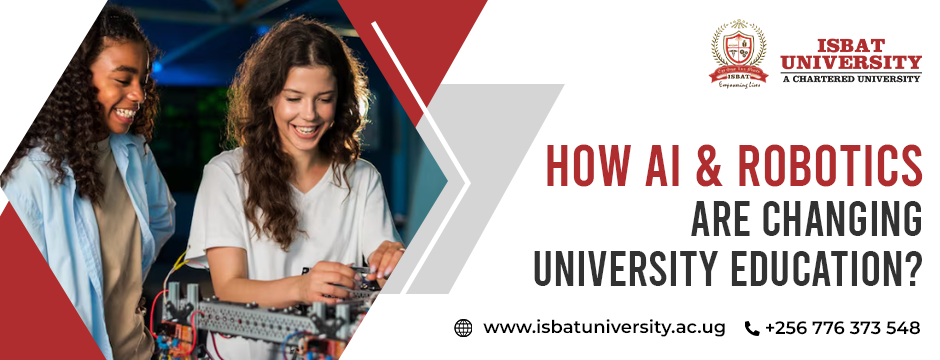
How AI & Robotics Are Changing University Education?
February 23, 2026
University education is undergoing one of the most transformational shifts in its history. The convergence of artificial intelligence (AI) and Robotics courses in Uganda is not just about futuristic labs and sci-fi imagery — it’s a real, tangible evolution that’s reshaping how students learn, how educators teach, and how institutions operate. For decades, universities relied on traditional classroom lectures, textbooks, and standardised assessments. Today, these methods are being augmented — and in some cases replaced — by intelligent systems that personalise learning, analyse academic performance in real time, and automate routine educational tasks.
This change isn’t happening in isolated pockets; it’s becoming foundational across disciplines — from engineering and medicine to arts and humanities. Imagine a campus where AI tutors help students struggling with calculus at 2 a.m., or robotic lab assistants guide biology experiments with impeccable precision. Envision faculty using data-driven insights to predict which students need extra support or to enhance curriculum relevance based on real-time trends. These innovations are not merely enhancing efficiency — they are redefining the purpose of higher education, making learning more adaptive, inclusive, and future-ready.
Personalising Learning with AI
One of the most powerful contributions of AI to university education is personalised learning. Unlike traditional one-size-fits-all lectures, AI systems can analyse each student’s strengths, weaknesses, and learning pace to tailor content to individual needs. Adaptive learning platforms use machine learning algorithms to continually assess student performance and modify instruction accordingly. Students who grasp a concept quickly can move ahead, while those who need more time receive additional resources and practice opportunities. This reduces frustration and increases mastery.
Moreover, AI-powered tutoring systems are available 24/7. These virtual tutors can answer questions, explain complex concepts, and provide feedback — all without human intervention. This democratizes learning, as students no longer have to wait for office hours or appointments to get help. For professors, AI analytics provide insights into class performance trends, enabling early intervention for students at risk of falling behind. These systems empower educators to make data-driven decisions rather than relying solely on intuition.
Automating Administrative Tasks
AI and Robotics courses in Uganda are also revolutionising the administrative backbone of universities. Many processes — from admissions and scheduling to grading and academic advising — have historically consumed enormous staff time. AI tools can automate these repetitive tasks with greater speed and accuracy. For example, natural language processing (NLP) can parse student applications, sort them based on criteria, and even flag exceptional candidates. Chatbots answer common student queries instantly, reducing wait times and freeing staff to focus on more complex or human-centred tasks.
Automated grading systems can handle multiple-choice tests and even evaluate essays with surprising sophistication. While not a complete replacement for human assessment — especially for creative or subjective work — these systems significantly reduce faculty workload and accelerate turnaround times. Intelligent scheduling systems can optimise class timetables, room assignments, and resource allocation based on variables like student preferences, faculty availability, and room utilisation. This makes campus operations more efficient and responsive.
Enhancing Hands-On Learning Through Robotics
Robotics in university education goes beyond industrial labs. It enables students to gain hands-on experience in a risk-free, highly controlled environment. In engineering programs, robotic kits and simulators allow students to design, test, and iterate on real hardware without expensive equipment. In healthcare education, surgical robots and simulation systems let medical students practice complex procedures with precision and feedback. These tools reduce the learning curve and improve clinical readiness.
In fields like archaeology, agriculture, and environmental science, robots and drones take students into terrains that would otherwise be inaccessible or dangerous. By integrating sensor data and real-time control, students can collect and analyse field data remotely. Robotics also fosters collaborative learning. Projects often require interdisciplinary teams, blending coding, mechanics, and critical thinking. Students learn not only technical skills but also teamwork, communication, and problem-solving — competencies coveted by modern employers.
Revolutionising Research with Intelligent Systems
Universities are research powerhouses, and AI systems are accelerating discovery in unprecedented ways. In scientific research, machine learning models can sift through vast data sets to identify patterns, correlations, and insights that would take human researchers years to uncover. AI assists with literature reviews by summarising articles, detecting trends, and highlighting gaps in scholarship. This gives researchers a powerful advantage in staying current and driving innovation.
Robotics enhances experimental throughput. In labs, robotic arms can handle sample preparation, testing, and data capture with remarkable precision and reproducibility. This frees researchers to focus on designing experiments, interpreting results, and pursuing creative inquiry. Collaborative robotic platforms also facilitate remote experimentation — a boon for global research partnerships. Teams from different continents can design and run experiments without physical presence, expanding the possibilities for cross-disciplinary breakthroughs.
Preparing Students for the Future Workforce
The integration of AI degree programs Uganda and robotics into university education isn’t just about improving current systems — it’s about preparing students for a future where these technologies define the job landscape. Employers increasingly seek graduates who are not only tech-literate but also capable of working alongside intelligent systems. Universities that embed AI and robotics into their curriculum give students a competitive edge, equipping them with real experience in emerging tools and methodologies.
Courses in data science, robotics engineering, computational thinking, and AI ethics are rapidly expanding. But beyond formal coursework, students engage with these technologies through capstone projects, internships, and research assistantships. This exposure helps graduates transition seamlessly into careers in automation, machine learning, autonomous systems, healthcare technologies, and more. Even in fields not traditionally associated with technology — such as law, education, or business — understanding AI’s implications is essential.
Challenges, Ethical Considerations, and Human Touch
Despite the advantages, integrating AI and robotics into education raises questions and challenges. Concerns about data privacy, algorithmic bias, and equal access must be addressed proactively. If historical data reflects disparities, AI recommendations can inadvertently perpetuate inequity. Institutions must ensure transparency, fairness, and accountability in their AI deployments.
Moreover, while automation enhances efficiency, it cannot replace the human elements of mentoring, inspiration, and social learning. Determining the right balance between technology and human interaction is essential. Educators must be trained not just to use technology but to guide students in ethical, creative, and empathetic thinking. Cybersecurity is another concern. As campuses become more connected and data-driven, protecting systems from breaches is paramount.
Wrapping Up
AI and Robotics courses in Uganda are not futuristic concepts trapped in labs or movies — they are actively reshaping university education today. From personalised learning paths and streamlined administration to immersive hands-on experiences and accelerated research, these technologies are building a more adaptive, efficient, and future-ready education ecosystem. Students gain autonomy in learning, educators gain data-driven insights, and institutions gain agility in meeting the demands of a rapidly changing world.
For students and educators seeking a forward-looking academic environment that embraces innovation while nurturing growth, our ISBAT University in Uganda exemplify this vision. With programs designed to integrate contemporary technologies with real-world relevance, we prepares learners to thrive in an era defined by AI and robotics, empowering them to become leaders in a future shaped by intelligent machines and human ingenuity.
Since 2006, ISBAT University is ranked consistently among the top higher education institutions in Uganda.